



Throughout this series on Gen Z and the legal profession, one message has been clear: Gen Z lawyers are not turning away from the legal profession. Instead, younger lawyers are challenging law firms, universities and regulators to rethink how legal careers are structured and experienced. Flexibility, wellbeing, purpose and clear career progression are no longer optional extras; they are increasingly shaping how Gen Z lawyers choose where to study, work and build a long-term legal career.
The question is how the legal sector will respond to these expectations. Employers, universities, training providers, professional bodies and regulators all have a role to play in shaping the future of legal careers. Each faces a different challenge, but all share the same reality of a workforce whose priorities can no longer be ignored.
For Employers and Law Firms: Stop Saying It, Start Showing It
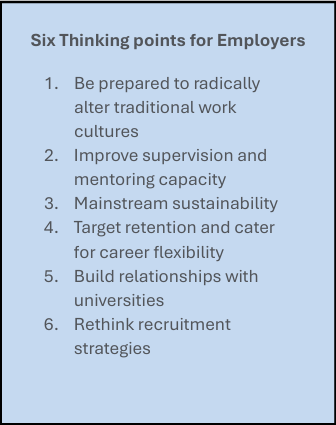
Much of the conversation around Gen Z focuses on recruitment. But attracting young talent is only half the battle. The real challenge is whether firms can create environments where that talent actually wants to stay and translate those aspirations into everyday practice
The gap between policy and reality is where organisations will be tested. Diversity commitments, wellbeing initiatives and flexible working policies have become common features of employer branding, but younger lawyers are evaluating their prospects based on what they experience rather than what they read on a website.
Hybrid working provides a useful example. According to the IBA Future of Legal Services Commission report on the attractiveness of the legal career to Gen Z, more than three-quarters of respondents said they would consider seeking alternative employment if required to work onsite full-time, suggesting that flexibility is increasingly viewed as an expectation rather than a perk.
How Can Law Firms Respond?
- Ensure diversity and inclusion are visible in culture and practice, not just recruitment brochures.
- Invest in mentoring, sponsorship and career development that’s genuinely meaningful, not tick-box.
- Embed wellbeing into workload management and team structures rather than a reactive fix.
- Embrace legal technology and AI in ways that boost both efficiency and employee experience.
For Universities and Training Providers: A Call to Modernise
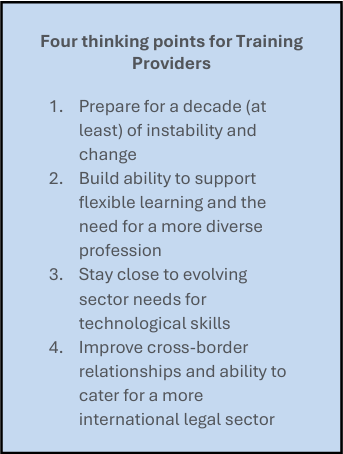
Law schools and training providers are facing a different challenge, which is preparing students for a profession evolving faster than many educational models were originally designed.
The legal profession continues to value strong technical legal knowledge, but employers are increasingly seeking graduates who can navigate technology, adapt to change and understand the broader commercial, social, and regulatory context in which legal services are delivered.
Many students also want legal education that feels connected to contemporary issues. Topics such as artificial intelligence, digital regulation, sustainability, social justice and ethical technology are becoming increasingly relevant across both legal practice and public policy.
The challenge is not to replace traditional legal education, but to ensure it remains relevant and adjusts to the realities of modern practice.
While core legal disciplines such as contract law, constitutional law and legal reasoning will continue to underpin the work of lawyers, students who also develop technological awareness, commercial understanding and practical skills will be especially well-prepared for the future of the profession.
How Can Universities and Training Providers Respond?
- Integrate legal technology, AI and digital literacy into legal education.
- Diversify curricula to reflect emerging areas of practice such as ESG, sustainability and technology governance.
- Expand flexible, online and hybrid learning opportunities that improve accessibility for a broader range of students.
For Professional Bodies and Regulators: Redefining Career Paths and Standards
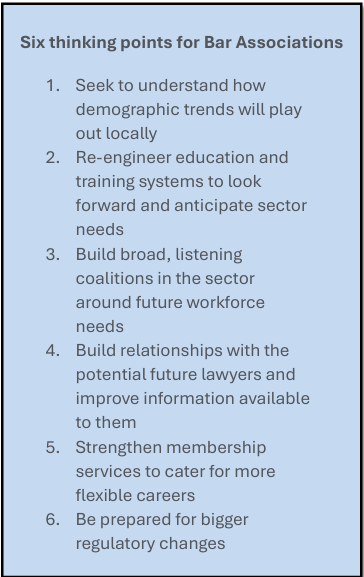
Unlike firms, regulators and professional bodies are not managing day-to-day workplace culture or delivering legal education like universities and law schools. However, they play a critical role in shaping who enters the profession and their career journeys.
Across many jurisdictions, qualification pathways remain lengthy, expensive and highly competitive. These systems were often designed for a very different professional environment and workforce. This raises questions about whether existing pathways are still the most effective routes into legal careers.
Recent developments such as apprenticeships, alternative qualification routes and modular approaches to training suggest that many jurisdictions are already exploring greater flexibility. These changes may help make the profession more accessible while maintaining professional standards.
Furthermore, regulators have an important role in encouraging discussion around sustainable careers, wellbeing and retention. As concerns about burnout and workplace culture grow across the profession, these issues are being viewed not simply as organisational challenges but as matters that affect the long-term health of the profession itself.
How Can Professional Bodies and Regulators Respond?
- Continue exploring flexible and alternative qualification pathways.
- Promote accessibility and diversity across routes into the profession.
- Work with employers and educational institutions to ensure qualifications remain relevant to modern practice.
Conclusion: Closing the Gap Between Expectation and Reality
The profession continues to attract talented young people who are drawn by its intellectual challenge, influence and potential for social and economic impact. What has changed are the expectations of how legal careers are built and experienced.
Many of the issues discussed throughout this series, such as flexibility, wellbeing, inclusion, purpose and accessible career pathways, are not entirely new. What is different is the extent to which younger generations are willing to act on these priorities when deciding where to study, work and build their careers.
For employers, training providers, and regulators alike, the challenge is how they are going to respond to close the gap between expectation and reality to attract this generation of talent and strengthen the profession for future generations as well.
This concludes our three-part series on Gen Z and the legal profession. Thank you for following along as we explored how changing workforce expectations are shaping legal education, legal careers and the future of the profession. We look forward to continuing the conversation through future insights on the evolving legal sector.